

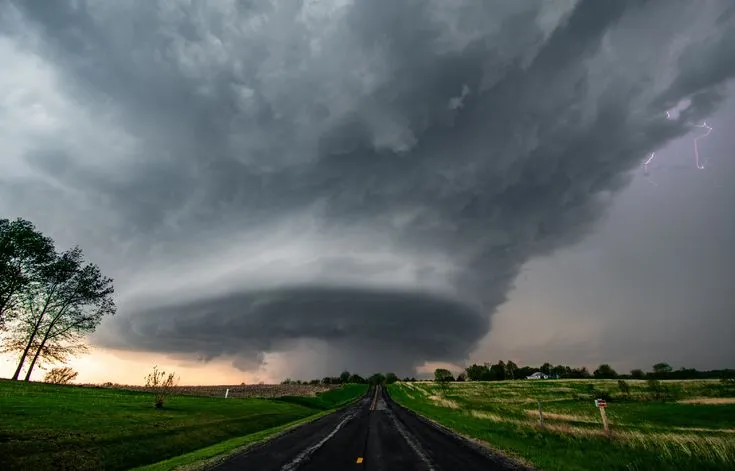
Some thunderstorms appear as little more than dark clouds followed by rain. Others develop a shape and scale that immediately command attention. Supercells belong to the latter group. For travelers exploring storm chasing tours USA 2027, seeing an organized storm across an open Plains horizon can provide an entirely different perspective on severe weather.
The appeal is not limited to tornado potential. A supercell can display remarkable structure on its own, with towering cloud formations, a broad base, distinct precipitation areas, and features that evolve as the storm moves. Learning to look at the storm as a complete system allows travelers to appreciate details that might otherwise be missed.
Start by Looking at the Entire Storm
When something dramatic appears beneath a thunderstorm, attention naturally narrows toward that feature. Taking a wider view first can reveal much more. From a suitable distance, travelers may be able to see how different portions of the storm fit together. The upper cloud can stretch across a substantial section of the sky, while precipitation occupies another area closer to the horizon.
This broad perspective is one reason open country can be so valuable for storm observation.
The Updraft Gives the Storm Visual Scale
A supercell contains a persistent rotating updraft. Visually, the updraft region can contribute to the storm’s impressive vertical appearance. Travelers may see cloud towers rising high above the lower portions of the storm. Their scale becomes particularly noticeable when farmland, roads, or distant structures are visible beneath them.
For photographers, including these landscape elements can help communicate just how large the cloud structure appeared in person.
Rotation Adds Another Layer of Interest
Rotation is a defining feature of a supercell, but observing a rotating storm does not mean a tornado will necessarily form. Instead of treating rotation solely as a sign of one possible outcome, travelers can appreciate it as part of the storm’s organization. Changes in cloud structure over time may become more meaningful once guests understand that the storm is an evolving system rather than a static object.
This makes patient observation particularly rewarding.
Precipitation Changes the Storm’s Appearance
People interested in storm chasing tours 2027 may be surprised by how strongly rain and hail areas influence what they can see. Precipitation can obscure one section while leaving another portion of the structure clearly visible.
From an appropriate perspective, rain shafts can also become visually impressive features themselves. Light passing through precipitation may create strong contrasts, particularly later in the day. This means an area that initially seems to hide the storm can sometimes become one of the most photogenic parts of the scene.
Structure Can Change Within Minutes
A supercell does not maintain one perfect shape throughout its life. Its appearance evolves continuously.
Travelers might notice:
- New cloud growth above the storm
- Changes along the cloud base
- Expanding precipitation
- Different textures becoming visible
- Shifts in the storm’s overall shape
- Changing light across separate regions
Watching these changes over time provides a much fuller experience than taking one photograph and immediately moving attention elsewhere.
Distance Can Improve the View
Being closer does not automatically provide a better perspective. Large storm structures often become easier to appreciate when enough distance exists to see them in context. A wider view can reveal relationships between the storm, precipitation, surrounding clouds, and landscape. It also gives photographers more opportunities to compose images that communicate scale.
The most impressive perspective may therefore come from seeing more of the storm rather than trying to fill the entire frame with one small feature.
Landscape Makes the Structure More Dramatic
The Great Plains provide a particularly effective setting for viewing organized thunderstorms. Fields and broad horizons create relatively simple foregrounds beneath complicated skies. A road leading toward the horizon can emphasize distance, while a small building or tree line can demonstrate scale.
These compositions show why storm photography is often also landscape photography. The weather and the land work together to create the scene.
Every Supercell Has Its Own Character
No two storms need to look identical. Differences in atmospheric conditions, precipitation, lighting, location, and viewing angle can give each one a distinct appearance. One may be memorable for its broad structure, another for dramatic cloud texture, and another for the way evening light illuminates part of the storm. Recognizing this variety encourages travelers to observe each storm on its own terms rather than looking for one predetermined visual result.
Conclusion
Supercells are compelling because their scale, organization, precipitation, cloud textures, and constantly changing structure provide far more to observe than a single dramatic feature. Learning to view the entire storm can turn a chase into a richer visual and educational experience.
For weather enthusiasts traveling with Storm Chasing Adventure Tours, an organized supercell across the open Plains can become a highlight in its own right, demonstrating just how complex and visually remarkable severe thunderstorms can be.